
Anselm, Duns Scotus, and leg day
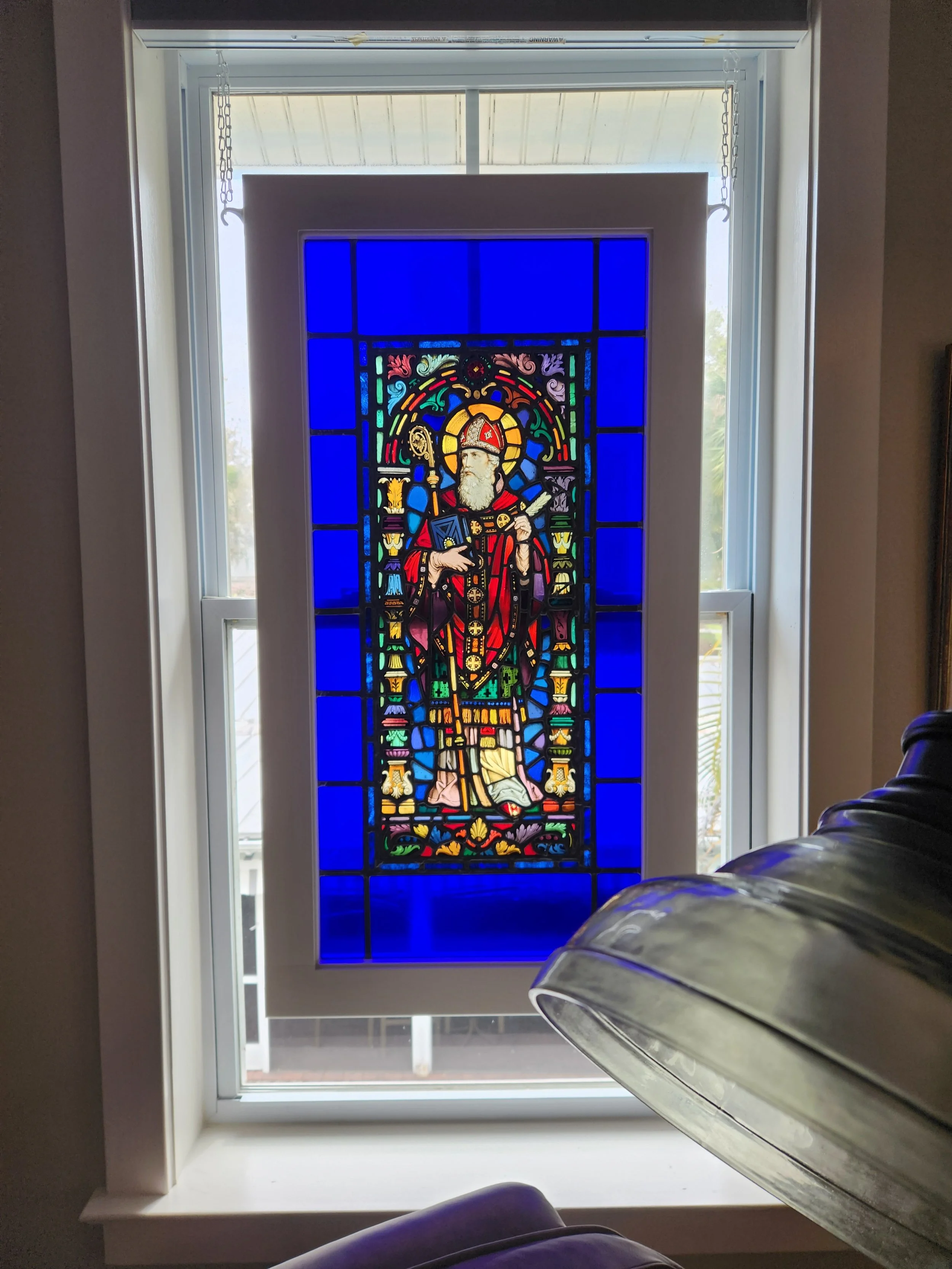
The Anselm window in my study at home
Monday, 12 January, being the Feast of Aelred of Rievaulx
I know I've assigned more of the Monologion than we can cover in one seventy-five-minute class session, but I've worked out a plan to hit the main points of natural theology, general metaphysics, and cognition and language.
Even that plan turns out to be overly ambitious.
It's a sunny day, warm enough that I'm happy to walk the 2.5 miles from campus to my new place. Over the course of the day I get my 10,000 steps in, and then some. That number actually originated in a marketing campaign for a Japanese pedometer, not from medical research—the benefits of walking tend to level off around 7500, from what I've read—but a little extra attention to staying lean while I build muscle won't go amiss.
Tuesday, 13 January, being Leg Day
When I last saw my Serbian trainer, he mentioned that his girlfriend was sick and he hoped he wouldn't catch whatever she had. He did, alas, but he set me up with another trainer for the first workout in my new three-day-split regimen. I woke up this morning with what felt like a scratchy throat. “Oh no!” I thought sarcastically. “I'll have to skip leg day.”
Leg day is at once my least favorite and most essential exercise day.
I was not, in fact, sick, and I showed up to meet the substitute trainer. I liked him well enough, and he certainly put me through my paces. There's not a muscle in my lower body that won't be shrieking tomorrow. A lot of those steps yesterday were classroom pacing. There may be a good bit less of that tomorrow.
My plan for the Scotus book is to have a short general introduction for each chapter before I dive into the specifics. This morning I drafted the introduction to chapter 2. Here it is:
Merely knowing that an agent is free in the sense described in chapter 1 tells us very little about how we can expect the agent to act. If all you know of me is that I’m free, you have no idea whether I will spend the afternoon writing about Scotus, practicing Bach’s E-major French Suite, plotting revenge against my critics, working on my golf game, or reading my nth Richard Russo novel of the year. You don’t know whether I’ll be tempted to leave the store without paying for the jewelry I’ve pocketed or to fall back on a face-saving lie instead of owning up to a difficult and embarrassing truth. But if you know something about my character, you can at least rule out some possibilities and expect others. I don’t play golf; I do play the piano. I am fortunately unlikely to steal, but I am lamentably prone to comfortable untruths. That I’m free means that you can’t infallibly predict what I will or won’t do—I can always act out of character, yield to a momentary moral lapse, or resolve to do better than I have done before—but my character, experiences, and values shape the ways in which I exercise my freedom.
God’s will is free in all his dealings with creatures. But that fact doesn’t tell us much about how God acts regarding creatures unless we understand whether, and how, God’s character and values shape the ways in which he exercises his freedom. (I won’t speak of ‘experiences’ in God’s case as I do in my own because God doesn’t really have experiences in the way that is relevant to human character formation.) Moreover, it seems plausible that God can’t act out of character in the way that I can. He is subject to no passion; his grip on justice, love, and mercy is in no way tenuous:
The steadfast love of the Lord never ceases,
his mercies never come to an end;
they are new every morning;
great is thy faithfulness.
In this chapter I look at divine justice, love, and mercy as attributes that, according to some writers, shape God’s exercise of his freedom with respect to creatures. In each case we will find Scotus denying that God’s moral attributes impinge upon his freedom.